
Reading The Wasteland
First pub. in Mental Floss, Nov. 2005

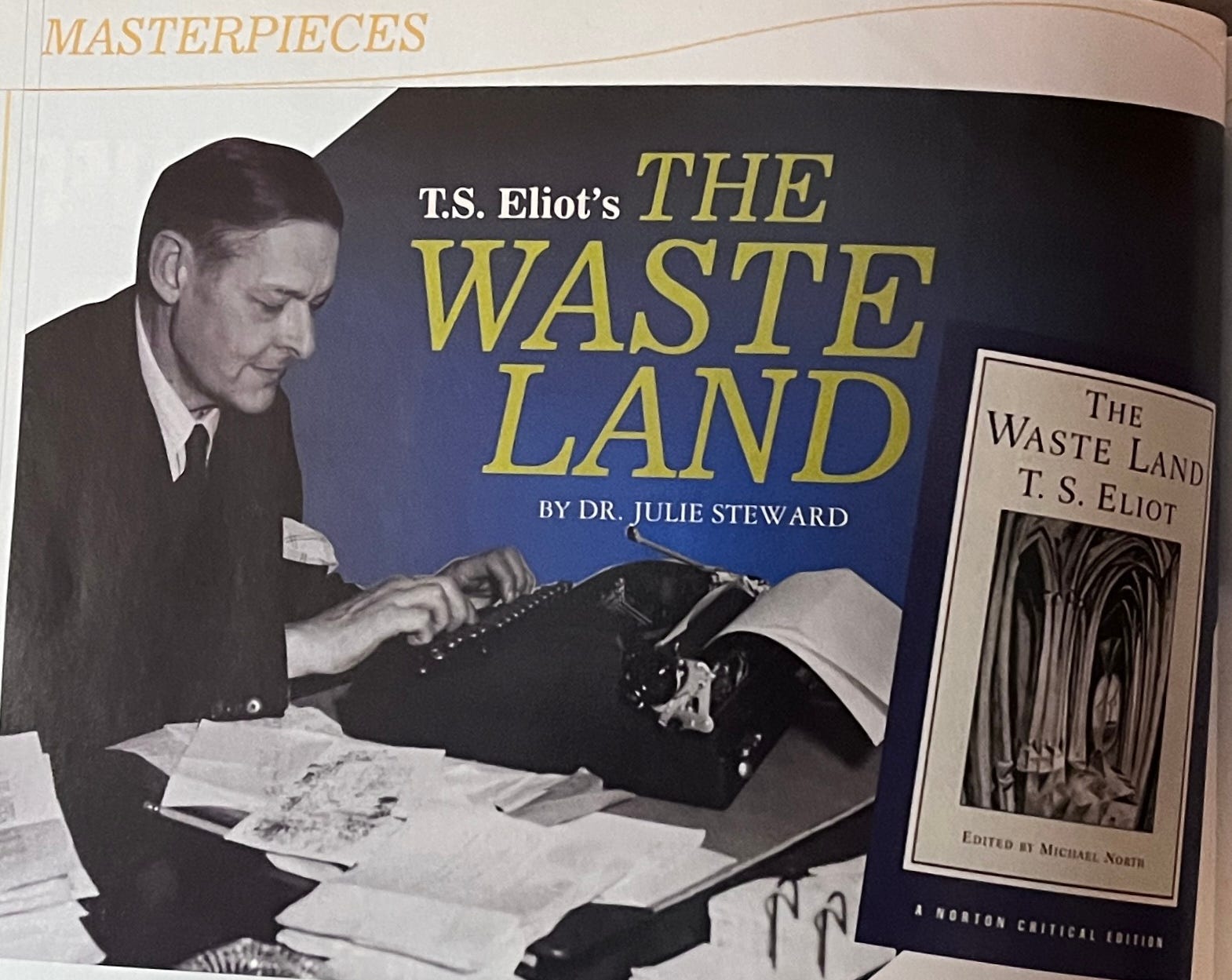
Don’t feel bad; you aren’t the only person who found it almost impossible to understand The Waste Land. After it was released in 1922, Time magazine was so baffled, it wondered if T.S. Eliot had written it as a hoax. And—thing is—that wasn’t the most unlikely speculation. Turns out, the author of one of the most depressing (and confusing) great works of Western literature was also a whoopee-cushion-loving jokester.
The Story
Eliot did enjoy a good prank, but The Waste Land was no hoax. When he completed the epic poem in 1921, Eliot was recovering from a nervous breakdown in a Swiss sanitarium, so it is not likely that he was in a joking mood. In fact, The Waste Land reads like a kind of literary “Apocalypse Now”—a five-part journey through the hell of post-World War I Europe. There is no cohesive voice and no cohesive plot. Rather, in the poem’s 433 lines, Eliot strings together a collection of images—making the “reading” experience feel more like watching a series of disturbing short films: A woman takes a frightening sled ride with her cousin. A psychic warns her customer to “fear death by water.” Zombie-type creatures wander aimlessly over London Bridge as a man meets an enemy soldier he faced in a war 2,000 years ago. A rat drags its slimy belly along the Thames River. A Phoenician sailor named Phlebas drowns.
Eliot offers some help along the way, though not much. A prophet named Tiresias (from Greek mythology) serves as a kind of guide through the work—only he’s blind and he changes sex every few years, so it’s still a bit confusing. And there are pages upon pages of footnotes meant to help readers navigate through all the allusions—only they tend to function as a red herring by complicating interpretation even further.
But The Waste Land is confusing because it’s meant to be. In the absence of a coherent narrative, readers must use imagination—the only saving grace, according to Eliot, against the waste land of modern life and the desolation, fear, and despair of the post-war world.
The Story Behind the Story
Thomas Stearns Eliot (1888-1965) was born in St. Louis, Mo., but he couldn’t get out of the Midwest fast enough. He moved to Massachusetts for a year of prep school, followed by college at Harvard. He then left the States altogether to study at the Sorbonne in Paris but returned to Harvard as a graduate student. On a fellowship, Eliot headed to England’s Oxford University in 1914, where he wrote a dissertation in philosophy. But the outbreak of World War I prevented him from returning home to defend his dissertation, so he settled in London. There, he did what any other self-respecting, unemployed Ph.D. would have done: found work in an entirely different field (banking) and started writing poetry.
In London, he met two of the most influential people in his life—and the biggest influences on The Waste Land. The first was his wife, Vivien Haigh-Wood, to whom he was unhappily married until she died in a mental institution in 1947. Vivien’s mental and physical illnesses, while distracting to the poet, intensified the despair of the poem and, according to Eliot, produced the state of mind from which The Waste Land came.
The second was the great Modernist poet Ezra Pound, who effectively served as the poem’s editor. In 1922, Eliot gave Pound a 1,000-line draft of The Waste Land, which Pound called “scrawling and chaotic.” Of course, he also told Eliot, “I am wracked by the seven jealousies.” Jealousy aside, Pound struck out more than half the poem’s lines so that its structure would more tightly focus on urban and spiritual decay.
When The Waste Land was published in 1922, most critics were just as baffled as Time magazine. Author Virginia Woolf praised it, but Modernist poet William Carlos Williams hated it enough to compare it to a bomb detonating on the world. Regardless, Eliot’s literary reputation was secured. He continued to write and gain notoriety, and in 1948, he won the Nobel Prize in Literature.
Why the Story Matters:
The Granddaddy of Modern Poetry:
The Waste Land ushered poetry into the 20th century. Its themes, such as apocalypse, chaos, and alienation, became staples of Modernist literature. And gone were traditional concepts of rhythm and rhyme. Eliot, a poetic master of juxtaposition, established meaning by placing unlikely images next to each other. St. Augustine, a corpse, and lines from Shakespeare’s play The Tempest may all appear in the same poem, and it is the reader’s job to find a meaningful connection between them. Ultimately, Eliot kicked all literary comforts to the curb. Plot and predictability are replaced by a collision of fragments—suggesting that if we are to find any coherent order in the modern world, we will have to look to the past.
That Line You Hear All the Time:
Nope, it’s not a reference to tax season. “April is the cruelest month …” is the first line of The Waste Land.
Mutual Admiration Society: T.S. Eliot and Groucho Marx?
The Waste Land isn’t exactly a laugh riot—so you wouldn’t know it, but T.S. Eliot was quite the prankster. It wasn’t unusual for him to give exploding cigars to visiting writers or place whoopee cushions in their chairs. And a 1950 Time magazine profile of the poet reveals this anecdote: “Once, on the Fourth of July, at a solemn board meeting of Faber & Faber [the publishing company of which he was a partner], [Eliot] set off a bucketful of firecrackers between the chairman’s legs.”
Apparently, the aspiring comedian in Eliot held a great admiration for Marx Brothers films, which led to one of history’s most unlikely friendships. A few years before Eliot’s death, the poet began writing fan letters to Groucho Marx. The two men even exchanged photographs, and Eliot wrote, “Your portrait hangs on my wall next to W.B. Yeats. You are my most coveted pin-up.” In response, Groucho replied, “I had no idea you were so handsome. Why you haven’t been offered the lead in some sexy movies I can only attribute to the simplicity of the casting directors.”
Eventually, Eliot sent a letter to Marx in 1964 inviting “you and Mrs. Groucho” to his home for dinner. So, what do you talk about with T.S. Eliot over appetizers? Well, Marx decided to prepare by reading Murder in the Cathedral and The Waste Land a couple of times and brushing up on King Lear just for good measure. When the night arrived, there was a lull in conversation, so Marx began quoting from The Waste Land. According to a letter he later wrote to brother Gummo, “Eliot smiled faintly—as though to say he was thoroughly familiar with his poems and didn’t need me to recite them. So, I took a whack at King Lear.” Following Groucho’s lead, Eliot amused himself by quoting jokes from “Animal Crackers” and “A Night at the Opera.” But the most important result to come from the dinner? Eliot gained street cred. The poet later proudly wrote Marx, telling him that news of his visit “greatly enhanced my credit in the neighborhood and particularly with the green grocer across the street.”
I love that Eliot was a prankster. Pranks are an art form. And a joyful one at that.
✌🏼❤️
I had no idea Eliot was like that. Wow, you never know about people. I second his admiration for the Marx Brothers.